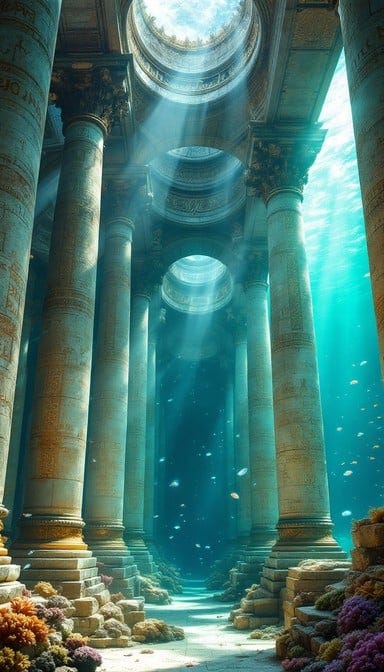
atlantean rhapsody

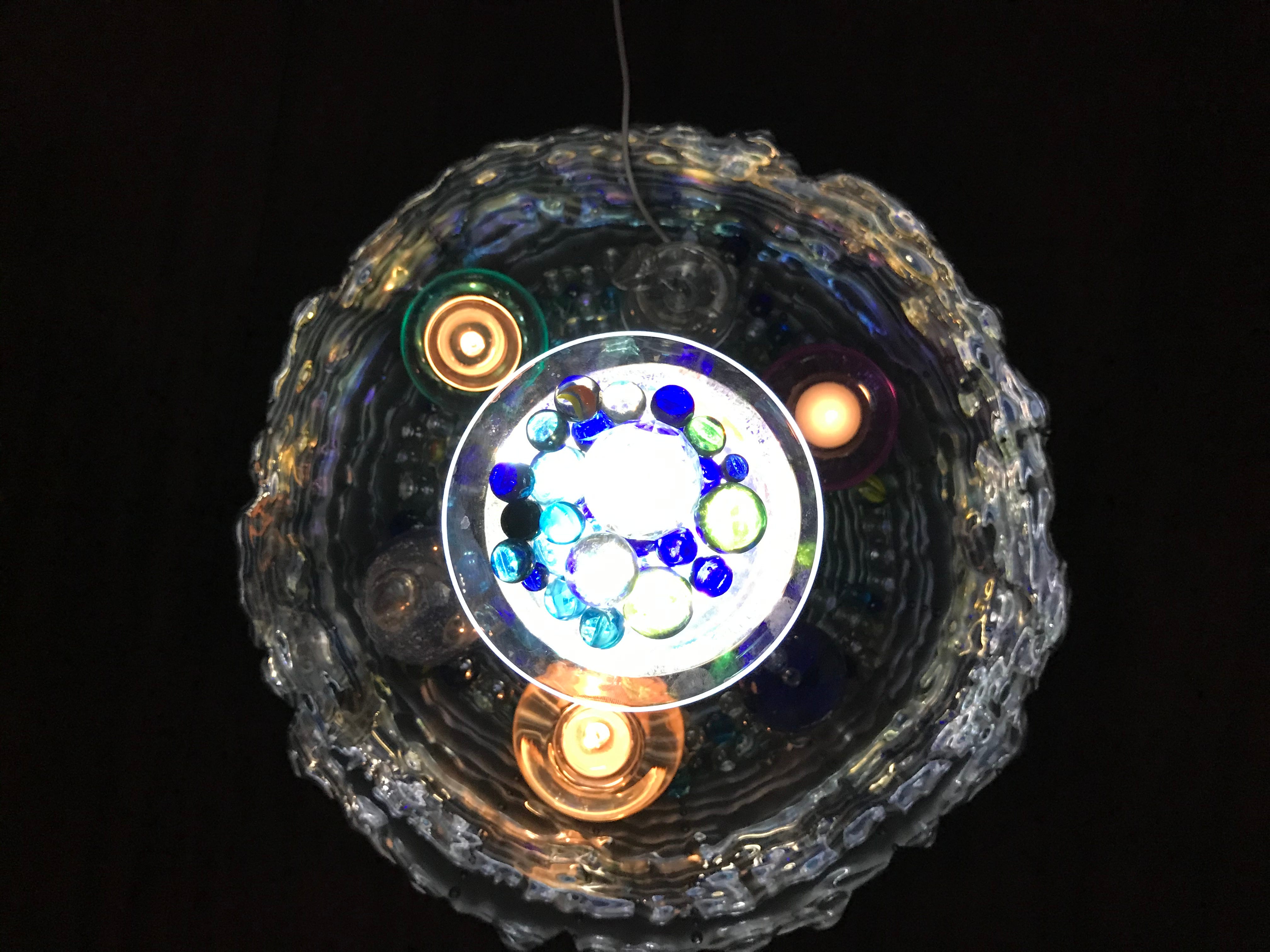
Night light:
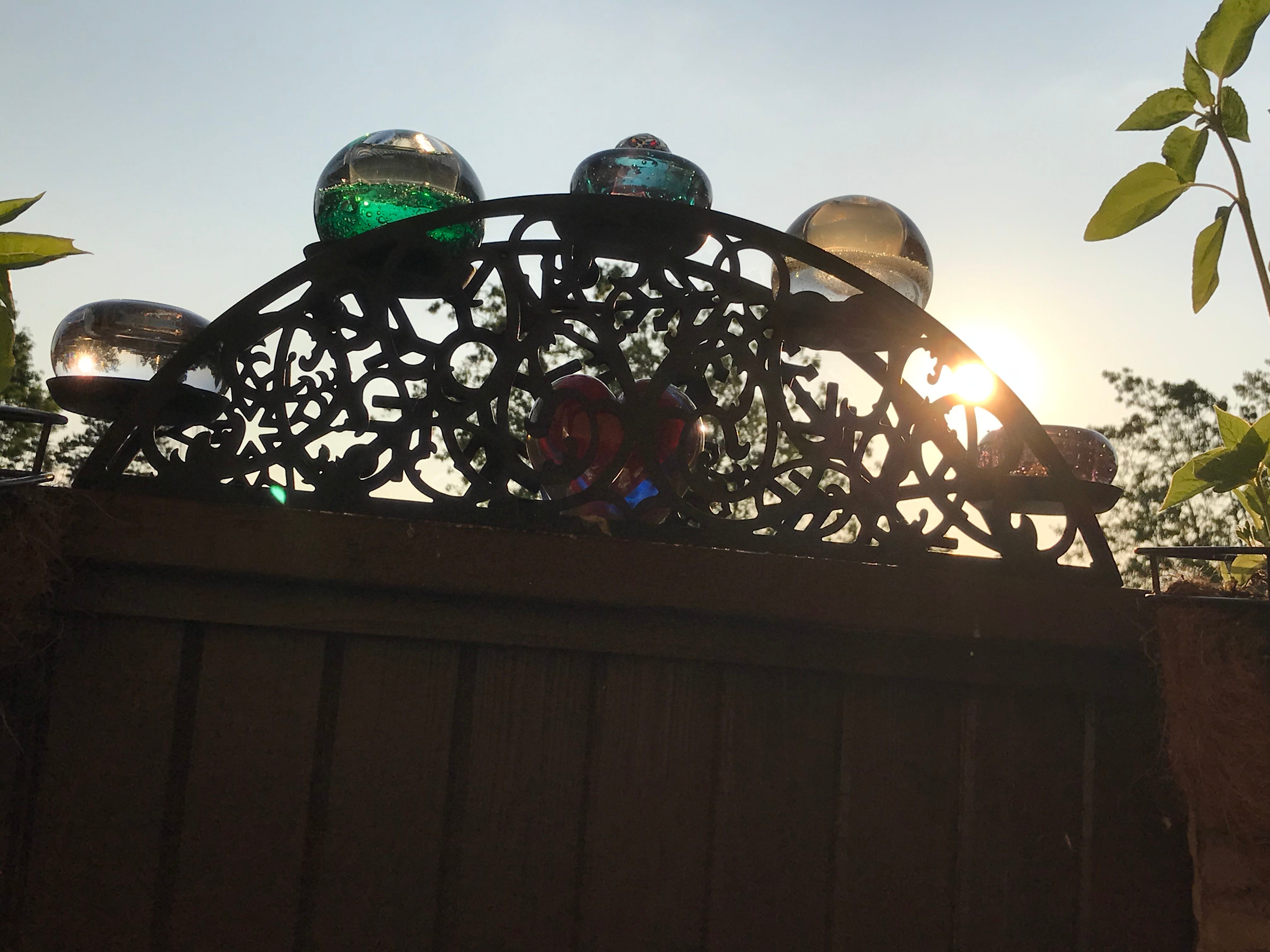
Day light:
Heaven Atlantis Temple Dream (not really a dream but rather an invented hallucination)
It was clearly designed. Temples are, by definition, products of intent not accident. But it wasn’t so apparently built. Any sign of construction -- seams, fittings -- were absent. Not as if it had been poured and set in some giant mold the size of Central Park, but that it simply all fit together and that was that.
Product of some ancient race? It’s as unsatisfying a theory as ancient gods, both of which place Halloween masks over riddles and call that plausible theory. Even ‘ancient’ was an unsatisfying concept, although the one thing certain was that the structure was far too old to be what it appeared to be, which was grandly Dorian, a temple in the Apollonian mode, although far better than anything the Greeks or Romans conceived.
It was singular: made for one person. While it held room for, oh, thousands, to comfortably inhabit, I was alone there and everything about it spoke of and to one alone.
Since time immemorial: I am trying to bridge time here, so bear with me. It is hard to bridge that which is itself the bridge of everything. Something about it spoke as much of aeons to come as aeons passed, aeons felt through wet feet on dry stone steps, aeons evaporating from the whorled prints of foot-soles on something shiny as granite but with the soft friction of sandstone.
It was surrounded by water in a properly circular horizon. The water was surely as old as the planet but, being water, perennially new, nascent as the first mating of hydrogen and oxygen.
From the main floor, a platform maybe fifty feet high above the water, the steps led down to disappear dozens on dozens below the curve of their refraction into vague trembling aquatic opacity. The columns of the temple roof sank equally deep, hundreds of feet down before disappearing.
It was difficult to spend time away from water’s edge, which served there as the seam of time. Lapping water made the stones wet, then dry, wet, dry, with the polite waves of a gentle surf brokered to gentility by an atoll ring barrier rendered in comfortingly plain pebble concrete.
One could walk to the atoll, maybe 400 paces, through water thigh-high if one followed one of seven rays connecting temple to atoll. Between these path-rays, the steps gradually rose from a depth too deep to see through, vision descending to the point one couldn’t count further as they blurred together like distant railroad ties.
Assuming the steps retained their uniformity and continued to the atoll, it was conceivable to count one’s steps along a ray to the atoll, and estimate the final depth via crude geometric figuring using water as evaporating ink on the lee side of the temple where the water line lay quiet like gently breathing glass. But somehow I could never complete the process. It was as if there were some event horizon of mystery preventing all the necessary factors from staying in my head long enough to complete what was really a very simple calculation.
Even if I could have completed the process, it would have told me nothing about the depth of water outside the atoll. For all I knew the planet was nothing but water.
***
The center of the temple roof, a vaguely vaulted dome, apexed gently into a massive lens, a giant marble, that sucked sun from above and spread it around the center interior.
***
Most days, cloudless, showed no change beyond the climbing sun’s arc and the identically various waves. The temple held no plants or statuary to occupy the eye, but it was an apophenic paradise. Absence of phenomena creates phenomena. The wind fluting the columns articulated complex sonic strata to the point I could see the wind through my ears. Gazing at a stretch of temple stone would reveal images in the grain and veinery, especially the darker portions. I recall daydreaming astonishingly, although I remember nothing of the dreams themselves.
Sometimes it was as if the world outside was really images cast on some inner eyelid’s dark vellum velvet. As if I might open some eyelid’s eyelid to see beyond, especially at night when so many stars insisted, against the blackness, that there must be something behind them.
The daytime’s apophenia didn’t extend into the night. I never saw anything in the stars but light, dark, and wonder. They were too profound and perfect for the mind to see anything in them but what they were. Eventually I would sleep, void dreamless sleep from which I would awaken the next morning to the astonishment of everything being exactly the same as the morning before, not even a dot on the horizon.
Clouds appeared infrequently, and when they did, almost always alone. One glimpsed them as remote specks at horizon’s edge that headed for the temple with a curious accretion, seeming to growing larger as they approached, until they covered most of the sky, a shade that always was ringed by distant blue sky and, sometimes, the sun low on the horizon.
Or, once, a massive cloud bank on the horizon that gradually shrank until arriving overhead a faint gauzy blob which, precisely blocked the sun above (which always rose straight from a pure east to a perfect zenith in the high center of the sky, then set in a perfect west, as if I were on the equator of a planet that rotated in an exact right angle to its orbit around the sun), while covering the temple below in shadow perfectly matched to the temple.
A maddening but comforting sense of sentience: whether they were aware of me or not, I and my temple were obviously the center of things. (The sense of complete and unchallenged possession was so complete as to occlude me ever asking if there might be someone else.)
***
The color of the steps and the shade of the temple roof made it impossible for me to see my reflection as anything but a vague, head-shaped thing with a silhouette of hair that, thankfully, looked like my hair.
***
I remember thinking that if I took careful measurements and records, a pattern would emerge, a sort of meteorological solstice and equinox. I also remember thinking that it was prejudice on my part to assume the planet orbited the sun; it could as well be that the sun orbited the planet.
The stars, breath-taking to the point of spiritual anoxia, were inconsistent. There were constellations, yes, but they appeared with no discernible regularity, as if the entire solar system of this planet gimbaled in several directions at once. Their appearance in relation to the night’s passage was totally erratic.
(But the constellations appeared in the same configurations in relation to each other, giving me the sense of assurance that I was at least in the same Big Dippered universe as the one I remembered growing up in.) One of them I thought I recognized.
Because the horizon showed no feature, it was impossible to accurately mark where the sun rose or set. I tried marking the spot with my own blood on the temple’s edge, but my veins leaked only water pure as that of the ocean, and my urine was salt-less and odorless; the one quality distinguishing it from the ocean was its warmth, which it lost immediately on contact with the sea.
***
No tools. Nothing with which to make anything with except water, capricious splashes, quivering pools of hand-cupped water-paintings that quickly dried on the temple steps, exhaled breath. Water served not just thirst but whatever hunger I felt, not a physical sensation, really, but a vague emotion, sort of a vestigial teleology. A trace of simple blind purpose that soothed the soul.
***
I sometimes thought I should feel like a pet abandoned by its master: all my basic needs were perfectly met with obviously purposeful intent, but I never felt that way. I felt like the keeper of a lighthouse soul. A dog-whistle foghorn. A prayer beacon sent aloft, searching the heavens for someone to whom it might deliver its message. In short, I felt I had some purpose and belonged there.
***
What made it heaven more than anything was that I knew the place was far too good to be real but far too real to be otherwise. It was heavenly because it shouldn’t be so, because what couldn’t possibly be so obviously was, and this conflict prevented complacency. This was no vacation; there was no escaped-from life to return to next week; nor was it possible to get used to this place except to constantly remark its wonderfulness. Unlike the music of the cosmic sphers which we cannot hear because their sound has been constant since we were born, the music of this place was new and fresh, changing just enough to stay the same, a sameness one never got used to.
One’s inescapable belief the ground underfoot would vanish at any moment made reality delightfully, blessedly reassuring.
What makes it Paradise Lost but not The Fall is that I remember it as clearly today as five months ago when I left it one day, swimming out into the water until I was too exhausted to go further or swim back.
Why suicide from Heaven? To die happy, of course. The obvious ancientness of the place, evoking if not immortality at least time enough and then some, chafed at my belief in my mortality. While it seemed deeply possible that being there meant I too was immortal or close enough, I didn’t feel that way. Immortality is a state of mind not being. Being immortal is impossible to experience, of course, since there’s always another day ahead. One cannot be immortal forever, only a golden afternoon, or swim-bright morning, at a time.
So one day when I felt thoroughly sated by immortality, I took matters in my own hands and swam to my death, thereby proving my mortality for at least awhile, which is as long as mortality can be proven, and waking up afterward on a park bench to a cruelly cold winter morning, naked but for a few dozen yards of heart monitor printout sheets.
Wrapping them around me like an over-rolled cigar, I watched the sun of a planet I knew quite well rise through the trees of a Central Park I’d never seen but instantly recognized since there is, after all, no other place like it on earth except a few thousand TV shows, movies, and other images.
Sunrise became heart monitor blinking green and the annoying feeling of E.R. tv reruns.
Some nurse said my name with annoying insistency. It wasn’t her effort to awaken me that I disliked, but the way she used my name, as if she -- or anyone -- knew me. Insisting I was Kenmeer.
“Kenmeer. Kenmeer? Kenmeer. Try to keep your eyes open, Kenmeer.”
Kenmeer, this odd name my parents chose, means, if you translate Ken from Scottish and meer from German, ‘view of the sea’.
Livermaile? It’s Dutch, and best I can tell, means ‘kiddie time’. Used to have an umlaut, I think. Dad met Mum overseas in the Air Force. Wasn’t happy about things in the States -- McCarthyism -- so he married with Mum’s last name so he could become a Dutch citizen. Changed his mind in ‘53 when Edmund R. Murrow stood up to the fat bastard on national TV, but neither of them saw any reason to change the last name. Dad said it was kind of handy having two last names. Flexible options, he said. They moved to the States, where I was born soon thereafter.
Let’s call it an NDE although I never was clinically dead. It was a heavenly vision but calling it that cloys my gut and claws my brainstem. Some things don’t wear their names well. Like a child that wants to always be naked.<end>